
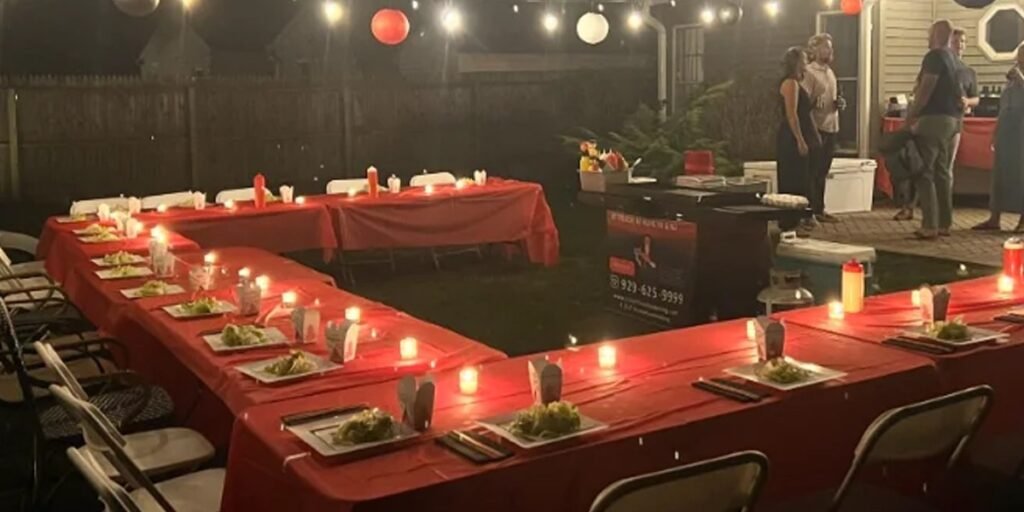
Moments that feel effortless to guests are rarely accidental. Behind every successful at-home dining experience lies a set of deliberate decisions that shape energy, pacing, and interaction. When evaluating formats like hibachi party at home, the real question is not what is served, but how the experience is structured.
At Crazy Hibachi, we have learned that memorable gatherings are less about menu selection and more about how people engage with the environment around them. That distinction changes how hosts think, plan, and ultimately choose the right format.
Why Hosting Success Depends on Experience Design, Not Food Alone
Food is often treated as the centerpiece of any gathering. In practice, it is only one variable.
Guests remember how a space feels. They recall whether conversations flowed or stalled. They notice whether attention was shared or fragmented.
Formats like hibachi catering at home introduce something different. Cooking becomes visible. Timing becomes collective. Guests do not disperse, they converge.
This shift transforms dining into a shared focal point. It reduces the burden on the host to “manage the room” and replaces it with a natural rhythm.
The Invisible Factors That Shape Guest Engagement at Home Events
Most hosts plan logistics. Few account for behavioural dynamics.
Through experience, several patterns consistently influence outcomes:
- Spatial alignment: Guests gravitate toward activity. Static setups encourage fragmentation.
- Attention anchors: A visible process, such as live cooking, holds collective focus.
- Pacing control: Events that unfold in stages sustain energy longer.
- Interaction triggers: Shared moments create conversation without forcing it.
In a typical home gathering, these elements are left to chance. In structured formats, they are designed.
The difference is subtle but decisive.
A Practical Framework for Evaluating At-Home Dining Formats
Not all catering approaches serve the same purpose. Choosing the right one depends on intent.
Below is a simplified decision framework:
| Objective | Best Format Type | Why It Works |
| High interaction | Live cooking formats | Creates shared focus |
| Low involvement hosting | Drop-off catering | Minimal effort required |
| Formal dining | Plated service | Structured and controlled |
| Social energy | Interactive cooking | Encourages movement and engagement |
Where hibachi party at home stands out is in its hybrid nature. It combines dining, entertainment, and structure without requiring excessive coordination from the host.
This balance is often underestimated.
Where Traditional Catering Falls Short in Social Settings
Traditional catering optimizes for efficiency. It is designed to deliver food at scale with minimal disruption.
However, in private residential settings, this creates unintended outcomes:
- Guests form smaller, isolated groups
- Food becomes transactional rather than experiential
- The host remains responsible for maintaining energy
Experiences like this reveal something broader about the industry. Many catering models prioritize delivery logistics, yet overlook social dynamics.
At-home events are not restaurants. They operate under different behavioural conditions.
Formats that acknowledge this difference tend to perform better.
Decision Signals That Indicate the Right Format for Your Event
Hosts often sense when a gathering needs something more, but struggle to define it.
Certain signals suggest a shift toward interactive formats:
- Mixed guest groups who may not know each other
- Events where conversation needs facilitation
- Celebrations where energy matters more than formality
- Settings where space allows for a central activity
When these factors are present, the format becomes more important than the menu itself.
At Crazy Hibachi, we have observed that successful events rarely hinge on complexity. They hinge on clarity of intent.
What This Means for the Future of At-Home Hospitality
At-home dining is evolving. Expectations are no longer limited to convenience.
Guests increasingly expect:
- Engagement without forced entertainment
- Quality without rigidity
- Experiences that feel intentional rather than assembled
This shift is reshaping how services are designed. The line between catering and experience is becoming less defined.
Experiences like this reveal another industry shift. The most effective providers are not those who offer more options, but those who reduce friction in decision-making.
Clarity is becoming a competitive advantage.
Move Beyond Food and Design the Experience
Memorable gatherings are rarely defined by what is served. They are defined by how people feel within the space.
A hibachi catering at home format works not because it is different, but because it aligns with how people naturally engage in social settings. It introduces structure where there is usually none.
The takeaway is simple. Hosting improves when the focus shifts from menu selection to experience design. Everything else follows.
FAQs
Is hibachi catering at home suitable for formal events?
Hibachi catering at home can be adapted for semi-formal settings, but it is inherently interactive. It works best where engagement and atmosphere matter more than strict formality. For highly structured events, plated service may be more appropriate depending on guest expectations and tone.
What type of space is needed for a hibachi setup at home?
A flat, open area is typically required to accommodate the cooking station and guest seating. Outdoor patios, backyards, and driveways are common choices. Adequate spacing ensures both safety and visibility, allowing guests to comfortably engage with the experience.
Does a hibachi party at home require active hosting?
One of the advantages of a hibachi party at home is reduced hosting pressure. The cooking process naturally draws attention, allowing the host to participate rather than manage. This creates a more relaxed environment while still maintaining structure and flow throughout the event.
When should someone choose hibachi catering at home over other options?
Hibachi catering at home is most effective when interaction, energy, and shared experiences are priorities. It works particularly well for mixed groups, celebrations, and social gatherings where engagement matters more than traditional dining structure or formality.