
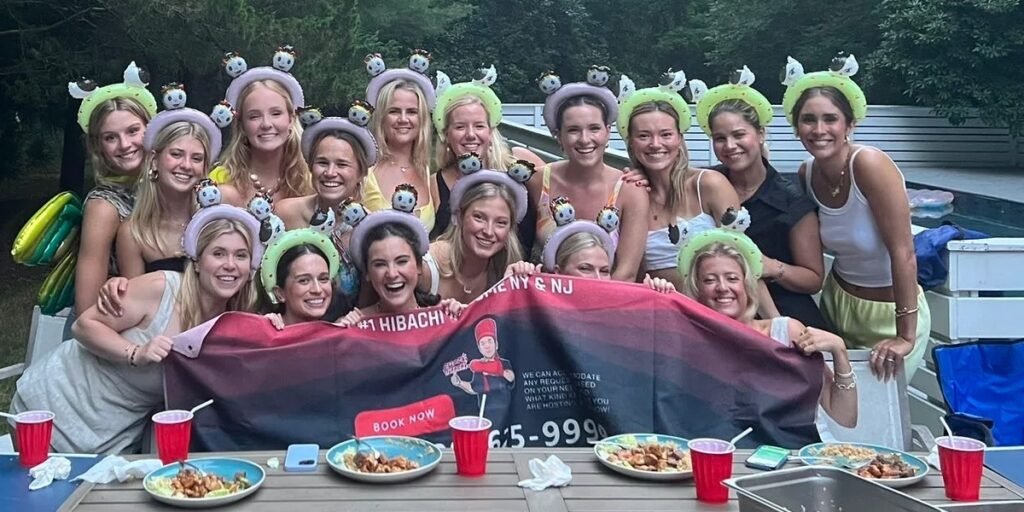
What is a backyard hibachi service? A backyard hibachi service is a live, chef-led dining experience where professional hibachi cooks prepare meals on a flat-top grill at a private residence, typically outdoors.
At Crazy Hibachi Catering Service, we bring the chefs, commercial-grade cooking equipment, and ingredients. The host provides seating, tableware, and the event space. The result is a structured, interactive meal that combines culinary skill, controlled fire cooking, and guest engagement within the comfort of a private home.
That definition sets the foundation. The execution determines the experience.
Understanding Hibachi and Teppanyaki Cooking
Many people use “hibachi” as a general term, but the cooking style most Americans recognize at Japanese steakhouses is technically teppanyaki.
Teppanyaki translates to “grilled on an iron plate.” It refers to cooking proteins, vegetables, and rice on a large, flat steel surface at high heat. The technique emphasizes timing, knife skill, and layered sequencing.
Traditional hibachi in Japan historically referred to a small charcoal heating device. In the United States, the term hibachi evolved to describe the theatrical flat-top dining style popularized in restaurants.
Our backyard hibachi service follows the American teppanyaki tradition, executed with professional equipment and structured pacing. It combines technical cooking discipline with controlled interaction, not improvised entertainment.
What We Bring to Your Backyard
At Crazy Hibachi Catering Service, our role is operationally focused. We handle everything related to cooking and culinary performance.
We provide:
- Trained hibachi chefs
- Commercial flat-top grill equipment
- Fuel sources and heat management
- Fresh proteins, vegetables, sauces, and rice
- On-site preparation and plating
- Controlled breakdown of cooking equipment
Our equipment is stabilized on level ground. Heat zones are defined clearly. Fire management protocols are standardized across events.
The objective is consistency. Backyard environments vary, but culinary execution should not.
What the Host Prepares
To keep responsibilities clean and pricing focused on food quality, hosts manage the surrounding event environment.
Hosts provide:
- Tables and chairs positioned around the grill area
- Plates, cutlery, bowls, and napkins
- Beverage service
- Trash and recycling access
- A cleared, level space for equipment
We do not provide furniture rentals or bartending unless arranged separately. That separation allows hosts flexibility. Some prefer disposable tableware. Others choose formal place settings for milestone events.
Clear role division prevents overlap and keeps the event streamlined.
How a Backyard Setup Works Step by Step
Decision readiness often depends on understanding the flow. A backyard hibachi service follows a predictable sequence.
Step 1: Pre-Event Confirmation
Guest count, menu selections, and layout details are finalized. We review space dimensions and access points.
Step 2: Arrival and Setup
Chefs arrive 30 to 45 minutes early. Equipment is positioned and stabilized. Fuel sources are secured.
Step 3: Guest Seating
Guests are seated around the grill perimeter. Sightlines are confirmed. Safe distance from the cooking surface is maintained.
Step 4: Live Cooking Sequence
Vegetables, rice, and proteins are cooked in timed progression. Interaction is controlled and appropriate for the audience.
Step 5: Breakdown and Exit
The grill is cooled and dismantled. Cooking debris is cleared. The broader event cleanup remains with the host.
This structure keeps timing efficient. Most backyard hibachi events run between 1.5 and 2.5 hours depending on guest size.
Safety, Space, and Logistics Considerations
Safety concerns are common. A professional backyard hibachi service addresses them systematically.
Key requirements include:
- Flat, stable surface
- Minimum clearance around grill
- Adult supervision for children
- Ventilation if partially enclosed
- No loose flammable décor near heat zone
Insurance coverage and internal safety standards are part of responsible operation. Clients should verify vendor insurance documentation before booking.
Urban backyards often surprise hosts. Even compact spaces can accommodate a grill if seating is arranged efficiently. Early layout planning eliminates last-minute adjustments.
When a Backyard Hibachi Service Makes Strategic Sense
Certain events align particularly well with backyard hibachi.
- Milestone birthdays
- Graduation parties
- Family reunions
- Engagement celebrations
- Corporate team gatherings at private homes
Why it works:
- Guests remain seated and engaged.
- Food is served hot and in sequence.
- The event has a defined start and end.
- Parents or hosts maintain environmental control.
Compared to traditional buffet catering, backyard hibachi limits foot traffic congestion. Compared to off-site restaurants, it removes reservation time pressure.
It is not the right fit for every event. Large-scale weddings with 100 plus guests may require expanded infrastructure. However, for controlled guest counts within residential settings, the format offers clarity and focus.
Operational Perspective From Our Team
Experience has shown that the strongest events are those with realistic guest counts relative to backyard size. Overcrowding reduces comfort and visibility.
We advise clients to evaluate:
- Seating capacity versus yard dimensions
- Noise ordinances in residential areas
- Lighting if the event runs past sunset
- Weather contingency plans
These considerations are practical, not promotional. Execution quality depends on planning accuracy.
Rewind
A backyard hibachi service is a structured, chef-led dining experience delivered directly to a private residence using professional flat-top cooking techniques rooted in teppanyaki tradition. At Crazy Hibachi Catering Service, we focus on culinary execution, safety standards, and defined process.
When hosts understand what we provide and what they control, the event unfolds predictably. Clarity before booking leads to confidence during the celebration.
FAQs
Can hibachi cooking be done inside if weather changes?
In some cases, yes, provided there is adequate ventilation and space clearance. Indoor setups must meet safety requirements related to airflow and heat dispersion. Site confirmation before the event is strongly recommended.
Is backyard hibachi safe for children?
When managed by trained professionals with defined cooking zones, hibachi is safe. Children should remain seated during active cooking. Adult supervision and clear safety boundaries are essential components of responsible hosting.
What type of events work best for backyard hibachi?
Birthdays, graduations, anniversaries, and small corporate gatherings align well with the format. The service works best when guest counts match space capacity and seating can be arranged around a central grill area.
How long does a typical backyard hibachi event last?
Most events run between 90 minutes and 2.5 hours depending on group size and menu selection. The structured cooking sequence provides a natural beginning, middle, and conclusion, which helps hosts manage overall event timing effectively.